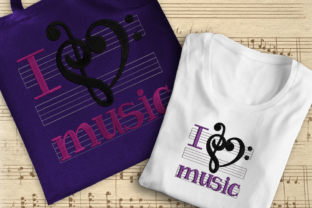
I Love Music
First Impressions: A Clever, Warm, and Instantly Recognizable Gesture
When I opened I Love Music for the first time, I didn’t just see lettering—I saw intention. The phrase “I heart music” lands with quiet confidence, but it’s the heart itself—woven from a bass clef and treble clef—that makes the design sing. It’s not literal; it’s lyrical. That interlocking clef-heart feels handmade in spirit, even as a machine embroidery design. It avoids cliché (no guitars or notes floating aimlessly) and leans into elegance instead of noise. For a craft business owner stitching custom tote bags for a local record store pop-up, this isn’t just decoration—it’s a shared wink between maker and music lover.
Where It Lives Best: Real Projects, Real Reactions
I tested I Love Music on a mid-weight cotton twill tote, a heather-gray sweatshirt, and a soft organic cotton baby onesie—and each time, the design held its voice without shouting. On the tote, centered above the pocket, it read cleanly at 4.2 inches wide: friendly, approachable, and unmistakably musical. On the sweatshirt, placed left-chest, it felt personal—not generic, not oversized—like something you’d choose for yourself or gift to a choir director or vinyl collector. And on the onesie? Delicate, tender, and surprisingly legible—even at 3 inches wide. Customers notice that subtlety. They pause. They smile. They say, “Oh—that’s *exactly* what my sister would love.” That kind of resonance is gold for Etsy sellers and boutique owners building trust through thoughtful detail.
Why It Works So Well for Handmade Products
- Visual clarity at scale: The clef-heart reads instantly, even from across a craft fair table—no squinting, no explanation needed.
- Emotional weight without clutter: No extra flourishes distract from the message. That simplicity translates directly to stitching reliability and customer perception of quality.
- Gender-neutral and age-flexible: It fits a teen’s cap just as naturally as a grandparent’s kitchen towel or a wedding guest’s embroidered napkin.
- Brand-friendly tone: Whether you’re curating a small shop’s holiday embroidery collection or designing digital embroidery files for other makers, I Love Music carries warmth without leaning into kitsch.
Where to Proceed Thoughtfully
This isn’t a one-size-fits-all embroidery file—and that’s a good thing. Its charm lives in its balance, so certain applications need extra attention:
- Small hoop sizes (under 4"): The clef-heart detail begins to compress. If stitching for a child’s cap or tiny patch, verify that the inner curves of the clefs remain distinct after stitching—not blurred or lost in satin stitch bleed.
- Textured or stretchy fabrics: On terry cloth towels or ribbed knit caps, stabilizer choice matters more than usual. A medium-weight cutaway helps preserve the clean edges of the heart shape and keeps letter spacing consistent.
- Dark or heavily dyed fabrics: The design relies on contrast. Test thread colors—especially for the “I” and “music” text. A slightly lighter gray or cream can lift the phrase beautifully on navy or charcoal, where stark white might feel harsh.
- Frequent-wash items (baby clothes, tea towels): Confirm stitch density supports durability. Overly dense fill areas may stiffen fabric; overly sparse running stitches could snag. A balanced mix of satin and fill stitch—typical in well-constructed embroidery files—will hold up best.
Design Judgment You Can Trust—Not Just Hype
As someone who’s stitched hundreds of designs for client projects and small-batch production, I judge I Love Music not by how pretty it looks on screen—but by how it behaves under needle and thread. Does it stitch smoothly across fabric types? Does it look intentional—not rushed or over-digitized—when finished? Does it elevate the product, rather than just occupy space?
Yes, yes, and yes. The letterforms are generous—not tight or cramped—so even lower-thread-count cottons render them cleanly. The heart’s negative space breathes; it doesn’t fight the fabric. And because the motif is rooted in real musical symbolism—not abstract shapes—it earns credibility with buyers who care about authenticity. That matters when pricing a handmade product or listing a digital embroidery file. Customers pay more for meaning they recognize—and craftsmanship they can feel.
Practical Designer Notes Before You Stitch
- Always test I Love Music on scrap fabric matching your final project’s weight and texture—especially if using textured weaves, knits, or dark backgrounds.
- Check thread color contrast in both natural and artificial light. What reads clearly on-screen may disappear on black fleece.
- Review stitch density visually—not just numerically. Look for smooth transitions between satin and fill areas, especially around the inner curves of the clefs.
- Confirm hoop size compatibility. If working with a smaller machine or tight placement (like a cuff or collar), measure the design’s bounding box before hooping.
- Inspect small details at 200% zoom: Are the terminals of the clefs sharp? Is the “heart” closure seamless? These nuances define perceived professionalism.
- Test a black-and-white mockup. If the design loses impact without color, it may rely too heavily on thread choice—not structure.
- Use appropriate stabilizer: cutaway for knits and stretchy fabrics, tear-away for stable wovens like quilting cotton or linen blends.
- Verify licensing terms before selling finished embroidered items or reselling the digital embroidery file. Commercial use isn’t automatic—even for seemingly simple phrases.
A Design That Earns Its Place—On Fabric and in Your Catalog
I Love Music isn’t flashy. It doesn’t try to be everything. But it does one thing exceptionally well: it communicates genuine affection for music—in a way that feels handmade, considered, and quietly confident. Whether you’re embroidering a holiday gift for a piano teacher, branding a small shop’s limited-run apron line, or adding curated design assets to your Etsy embroidery bundle, this piece holds its ground. It invites connection. It rewards attention. And most importantly—it stitches true.