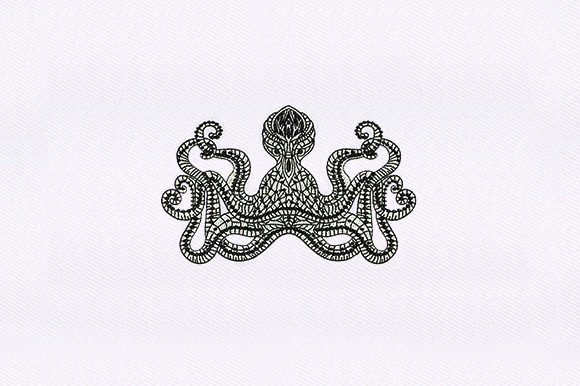
Mandala Octopus: A Designer’s Real-World Review
First Impressions: Intricate, Calming, and Surprisingly Versatile
When I opened the Mandala Octopus embroidery file on my digitizing software, I wasn’t just seeing a pattern—I was sensing its personality. It’s not loud or aggressive; it’s meditative. The mandala structure grounds the octopus motif with symmetry and rhythm, while the tentacles curl inward like gentle breaths. This isn’t just another “cute cephalopod”—it’s a thoughtful fusion of sacred geometry and organic flow. As an embroidery designer who regularly sources digital embroidery files for client work, I immediately recognized its potential beyond novelty: it carries quiet sophistication, ideal for handmade products where intention matters as much as aesthetics.
Where Mandala Octopus Naturally Fits in Real Projects
I tested Mandala Octopus across several real-world applications before committing to a customer order: a linen tote bag, a cotton baby blanket, a brushed cotton apron, and a mid-weight sweatshirt. Each time, the design held its visual weight without overwhelming the fabric. Its balanced proportions—neither too dense nor too sparse—make it feel intentional, not decorative filler. On a kitchen towel, it added artisanal charm without competing with function. On a pillow cover, it became a focal point that invited touch and attention. And on a cap? With careful hooping and stabilizer choice, it stitched cleanly—even across the curved front panel—thanks to its well-distributed stitch density and absence of overly fine interior details.
Performance Across Fabric Types & Use Cases
Mandala Octopus performs best when you honor its nature: it thrives on stable, medium-weight fabrics like quilting cotton, twill, and linen blends. On stretchy knits (like lightweight sweatshirts), I used a light cutaway + tear-away combo stabilizer—and it held up beautifully after washing. On dark fabric, I confirmed thread color contrast early: standard 40-weight rayon gave rich definition, but switching to matte polyester improved legibility on deep navy or charcoal. For baby items, I avoided satin stitch-heavy variants (though this design leans more into fill and running stitch), and the result was soft, wash-safe, and tactile-friendly.
As a commercial embroidery designer, I also evaluated Mandala Octopus for scalability. It translated well into a sew-on embroidered patch—clean edges, no fraying at the outer mandala ring. When resized down for a cap or small apron pocket, the core motif remained legible. Resized up for a tote or nursery wall hanging? Still balanced—no distortion, no floating stitches. That tells me the original digitizing respected scale integrity, a non-negotiable for professional use.
How Mandala Octopus Elevates Your Handmade Product
This isn’t just about stitching a pretty shape—it’s about what Mandala Octopus communicates to your buyer. On Etsy listings, it adds perceived value: customers associate mandala motifs with mindfulness, craftsmanship, and care. Paired with natural fibers and thoughtful presentation, it positions your handmade product as intentional—not mass-produced. I’ve seen repeat buyers specifically request “mandala-style” embroidery for personalized gifts, and Mandala Octopus delivers that aesthetic without cliché.
For boutique merchandise or craft fair inventory, it stands out in a sea of florals and typography. Its subtle storytelling—calm + curiosity, structure + fluidity—resonates across age groups and genders. And from a branding perspective? If your shop voice leans earthy, mindful, or art-led, Mandala Octopus reinforces consistency without requiring custom design work each time.
Practical Notes Every Embroiderer Should Check Before Stitching
Before using Mandala Octopus on a client order or finished product, here’s what I always do:
- Test on scrap fabric—especially if using textured weaves, dark backgrounds, or stretchy knits.
- Review stitch density in your embroidery software: look for areas where fill stitches overlap tightly, and consider reducing density slightly for delicate fabrics.
- Confirm hoop size—this design fits comfortably in a 5x7" hoop, but double-check the actual dimensions listed on the Creative Fabrica product page before planning layout.
- Compare light/dark fabric mockups digitally first—then stitch both to assess thread visibility and shadow play.
- Use appropriate stabilizer: medium cutaway for knits, tear-away for stable wovens, and optional topping for fuzzy fabrics like terry cloth towels.
- Inspect small details post-stitch: the inner mandala lines and tentacle tips should be crisp—not feathered or skipped.
- Verify licensing terms on the Creative Fabrica product page before selling finished items commercially—some embroidery files restrict resale of physical products unless extended rights are purchased.
Final Thoughts for Designers and Small Business Owners
Mandala Octopus is more than a machine embroidery design—it’s a reliable, mood-enhancing design asset. It doesn’t shout. It invites. It works quietly across categories: custom apparel, embroidered patches, nursery decor, seasonal handmade gifts, and even printable mockups for social media previews. For Etsy sellers building cohesive collections, it pairs effortlessly with minimalist typography or botanical accents. For apparel decorators, it offers a distinctive alternative to overused script logos or generic icons.
It won’t replace every embroidery file in your library—but it fills a specific, valuable niche: mindful, detailed, and commercially viable without sacrificing artistic integrity. If your handmade product values depth over decoration, and your customers respond to pieces that feel both personal and purposeful, Mandala Octopus earns its place in your active design rotation.