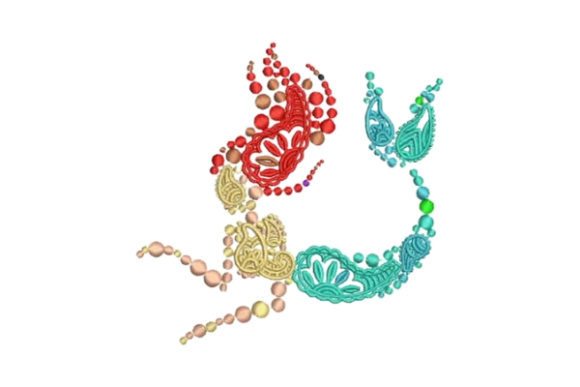
Mermaid Made of Paisley
A Design That Whispers, Not Shouts
First glance at Mermaid Made of Paisley isn’t about flash—it’s about flow. The curves are lyrical, the tail unfurls like smoke caught mid-twist, and those paisley motifs don’t sit *on* the mermaid—they *become* her scales, her hair ribbons, the gentle swirl around her shoulders. It’s not cartoonish or overly literal; it’s a mature, textile-savvy interpretation that leans into rhythm over realism. As someone who’s stitched hundreds of mermaid motifs for boutique baby blankets and Etsy sweatshirt collections, I immediately sensed this one would hold up in real life—not just on screen.
How It Landed on a Linen Tote Bag (My Real-World Test)
I used Mermaid Made of Paisley as the centerpiece for a limited-run linen tote—intended for a local artisan market. Linen’s slubby texture can swallow delicate satin stitch, but here? The design’s generous satin stitch areas held crisp definition, especially along the outer contour of the tail and the curved edges of the paisley “scales.” No skipped stitches. No puckering—thanks to moderate stitch density and well-placed underlay. What surprised me was how gracefully it scaled down: at 4.2" wide, the fine inner paisley details remained legible without bleeding or fuzzing. That’s rare in ornate machine embroidery designs.
Where It Shines—and Where It Needs Care
Mermaid Made of Paisley excels in projects where elegance meets wearability:
- Custom apparel: Works beautifully on mid-weight cotton sweatshirts and structured tees—especially when placed slightly off-center on the chest or upper back. The organic shape avoids the rigidity of boxy motifs.
- Baby embroidery: Soft, non-aggressive lines make it ideal for onesies and burp cloths—but skip ultra-thin interlock knits unless you add lightweight tear-away stabilizer beneath.
- Embroidered patch: Stitch it onto twill or denim-backed fabric, then cut and heat-seal. The clean satin edges finish crisply, and the paisley elements read clearly even at 3” height.
- Kitchen towel & apron design: Linen, cotton canvas, and tea towels all handle the stitch weight well. Just avoid placing it directly over seams or hems where tension shifts.
Proceed with extra attention on:
- Curved surfaces: Caps and beanies require careful hooping and possibly reduced density—those long, sweeping satin runs can distort if fabric stretches unevenly.
- Dark fabric: The design relies on satin stitch contrast. On navy or charcoal, test thread colors first—cream or heather gray reads warmer and more dimensional than stark white.
- Frequent-wash items: While stitch density is balanced, avoid using it on high-friction zones like pocket corners or elbow patches. It’s a statement piece—not a workhorse motif.
What It Does for Your Craft Business
As an Etsy seller and small shop owner, I judge designs not just by stitch count—but by perceived value. Mermaid Made of Paisley elevates a simple tote bag from “nice” to “thoughtfully made.” Customers notice the intention behind the paisley integration—the way the mermaid’s hair flows into a curling motif, how the tail fin echoes the classic teardrop shape. That subtlety builds trust. It signals craftsmanship, not clipart. For handmade product listings, it pairs effortlessly with soft photography and neutral backgrounds—no need to overstyle. And because it’s not tied to seasonal trends (no pumpkins, no snowflakes), it stays relevant year-round for personalized gifts, nursery decor, or wedding guest favors.
Design Notes Every Embroiderer Should Check
Before stitching your first Mermaid Made of Paisley project, do these five things:
- Test on scrap fabric—same type and weight as your final piece. Watch how satin stitch settles on textured weaves.
- Review thread color contrast in both natural and artificial light. A thread that pops on screen may mute on oat-colored linen.
- Confirm hoop size compatibility. This design spreads comfortably across a 5x7 hoop—but double-check the actual dimensions before loading.
- Inspect small details at 200% zoom in your embroidery software. Look for tight corners, tiny fill areas, or running stitch accents that may need manual adjustment on low-stitch-count machines.
- Check licensing before selling finished items or listing digital embroidery files. Commercial use rights aren’t implied—even for “multiple file formats.”
Final Thought: A Quiet Standout
Mermaid Made of Paisley won’t dominate a busy holiday sweater or shout from a festival cap. But that’s its strength. It’s the kind of machine embroidery design that earns second glances—not because it’s loud, but because it’s considered. It fits seamlessly into thoughtful product lines: a curated baby registry bundle, a set of embroidered kitchen linens, a small-batch capsule collection for a local boutique. It supports your brand voice instead of competing with it. If your craft business values nuance over novelty, and handmade presentation over mass-produced polish, this is one embroidery file worth keeping on speed-dial.