Donut: A Sweet Spot for Craft Fair Sales
First Impression: Playful, Approachable, and Instantly Recognizable
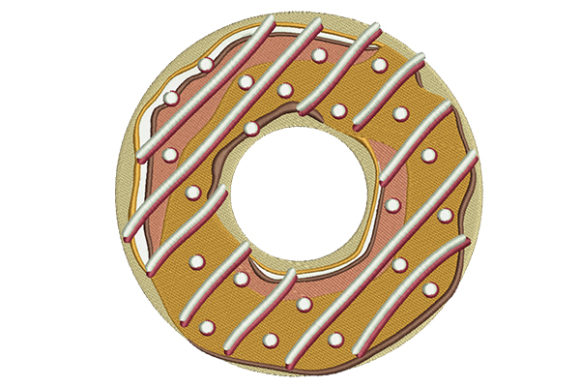
As an embroidery designer who’s prepped over 200 craft fair booths, my gut reaction to Donut is immediate: it’s a crowd-pleaser. It lands squarely in the “playful yet polished” zone—neither overly cutesy nor starkly minimalist. There’s warmth in its shape, charm in its implied texture, and just enough visual weight to read clearly from three feet away. That matters more than you think when shoppers are scanning your booth at 10 a.m. on a Saturday. Unlike abstract or ornate dessert-themed designs, Donut feels friendly, familiar, and commercially confident—ideal for small shop products that need to convert fast.
Where Donut Shines on Real Craft Fair Products
Not all embroidery designs translate equally across surfaces—and Donut proves especially versatile:
- Tote bag design: Centered on a natural canvas tote, Donut reads as bold, cheerful, and giftable—no extra text needed. It scales beautifully at 4–5 inches wide, holding clarity without overwhelming the fabric.
- Apron embroidery: Positioned just above the pocket or centered on the chest panel, it adds personality without competing with functional details. Its rounded silhouette softens the apron’s utilitarian lines.
- Tea towel embroidery: Works best on lighter-weight linen or cotton towels. The design’s clean outline holds up against subtle fabric texture, and its moderate stitch density avoids stiffness that can compromise absorbency.
- Embroidered patch: A standout option. When turned into an iron-on or sew-on patch, Donut becomes a repeatable, low-risk product—perfect for bundling, gifting, or adding to denim jackets at your booth.
- Caps and pouches: Use caution here. On curved cap fronts, test placement early—the roundness of Donut can distort if hooped too tightly. For small fabric pouches (3"–4" wide), scale down only to 2.25"; smaller risks losing definition in fill areas.
- Pillow covers and market bags: These are Donut’s sweet spots. Its balanced proportions anchor larger surfaces without demanding center-stage attention. Paired with neutral linens or oatmeal canvas, it elevates a handmade product without shouting.
What Makes Donut Sell—Beyond Just Being Cute
At craft fairs, attention is currency—and Donut earns it efficiently. It’s instantly legible, emotionally resonant (who doesn’t smile at a well-drawn donut?), and visually cohesive across multiple product types. That consistency strengthens your booth’s brand story: whether someone sees it on a tea towel, a patch, or a tote, they recognize your aesthetic. As an Etsy seller or digital embroidery file creator, this repeatability also supports cross-listing—Donut becomes a recognizable anchor in your shop’s design assets.
Photographically, Donut performs strongly. Its clear silhouette and moderate contrast between fill and outline make it easy to light and shoot on white or textured backdrops. It translates well into printable mockups for listings—no excessive shadowing or fine detail loss. And because it’s not reliant on tiny lettering or micro-details, it avoids common online disappointment triggers (“It looked bigger online!”).
Production Notes Every Embroidery Designer Should Check
Before cutting fabric or loading hoops, run these practical checks:
- Test on scrap fabric first—especially if using textured towels, thick denim, or dark fabrics. Stitch density may shift visibly depending on stabilizer choice and thread tension.
- Confirm thread colors match your intended palette. A warm brown fill with creamy beige outline reads “artisanal”; neon pink and lime green reads “party.” Choose deliberately—it changes perceived value.
- Review spacing and fill density. Dense satin-stitched centers or tight fill areas can pucker on lightweight fabrics. If your version includes sprinkles or glaze highlights, inspect how those elements hold up at 3" scale.
- Verify hoop size compatibility. If your machine requires re-hooping mid-design, factor in alignment time—critical when producing 20+ tote bags before show day.
- Use appropriate stabilizer. Tear-away works well for stable cottons; cut-away is safer for knits or stretchy blends. Skip fusible web unless testing confirms no ghosting on light fabrics.
- Create at least one real mockup. A finished tote or apron tells you more than any digital preview—how drape affects shape, how stitching catches light, how customers actually interact with it.
- Compare fabric colors side-by-side. Ivory linen vs. oatmeal canvas vs. natural burlap—Donut will read differently on each. What feels premium on one may look flat on another.
- Confirm commercial licensing. Since Donut is marketed as a machine embroidery design for handmade products, double-check terms before selling finished goods. Most reputable sellers allow commercial use—but never assume.
Careful-Use Considerations for Maximum Clarity
Donut is forgiving—but not invincible. Avoid pushing it into these scenarios without testing:
- Stitching on heavily textured terry cloth or looped jacquard—fine outlines may blur.
- Using ultra-thin thread (like 60wt) on dark fabric—low contrast kills readability.
- Scaling below 2" on curved surfaces (caps, curved pouches)—distortion risk increases.
- Layering over busy prints or high-contrast patterns—Donut needs breathing room to land.
- Assuming it auto-translates to puff or chenille—those techniques require redesigned files with adjusted underlay and density.
Final Thought: Donut Is More Than a Dessert Design—It’s a Booth Builder
In a sea of hand-painted signs and laser-cut wood, Donut stands out by being *embroidered*—not printed, not stamped, but stitched with intention. That handmade quality signals care, skill, and authenticity. When placed thoughtfully on a well-chosen product, it doesn’t just decorate—it invites touch, sparks conversation, and quietly raises perceived value. For craft fair sellers, Etsy sellers, and boutique makers building a recognizable line, Donut isn’t just another embroidery file. It’s a reliable, joyful, commercially smart piece of your creative toolkit—ready to sell, repeat, and resonate.